

Most people believe they are prepared. Most people are not. Here is what the plans that look solid on paper get catastrophically wrong, and what actually works.
There is a version of emergency preparedness that feels responsible. You have the generator. You have the canned goods. You have the water.
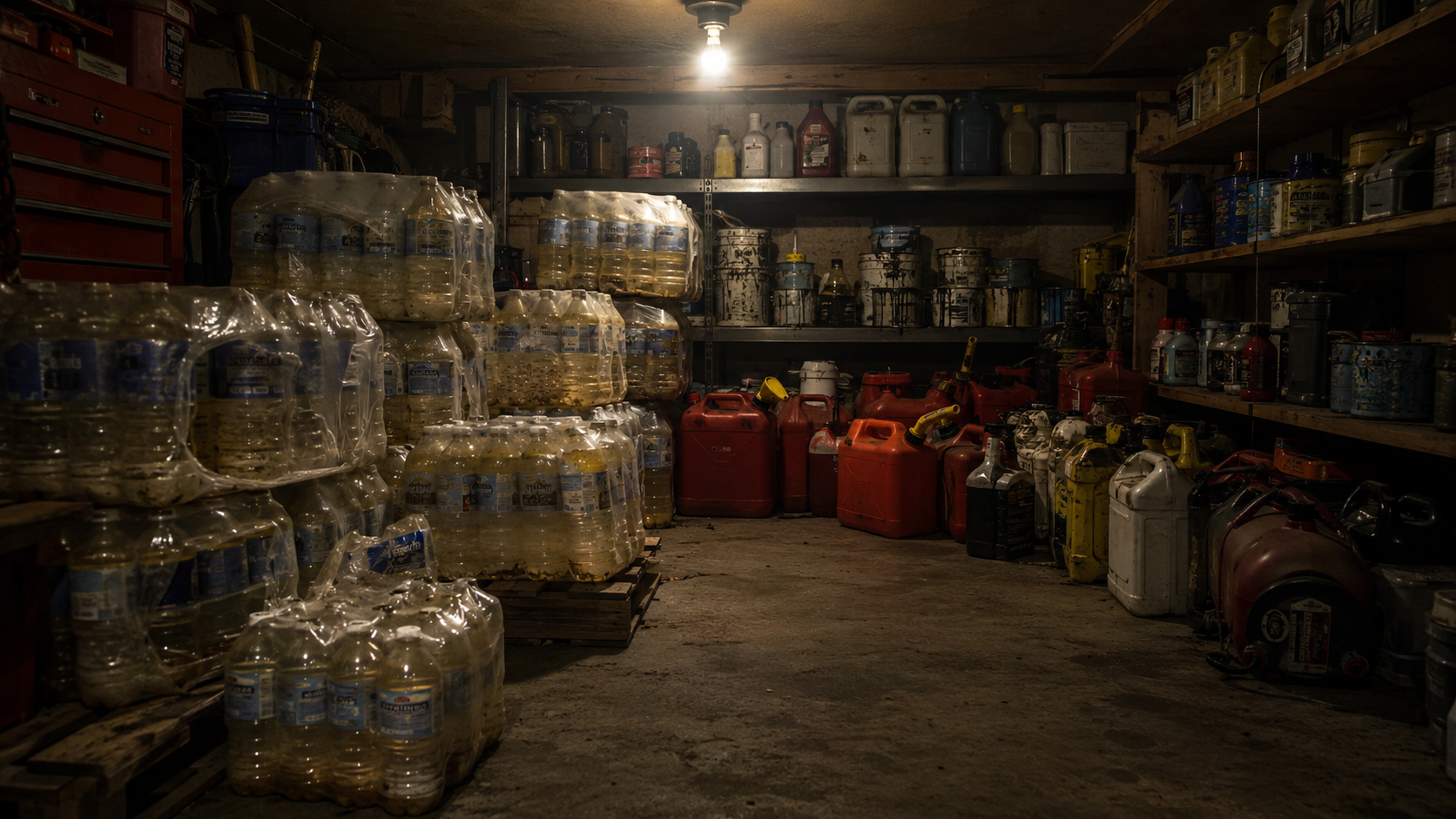
Dozens of bottles, maybe a pallet. Stacked neatly in a garage or a storage room. Ready to go.
Here is what most preparedness guides will not tell you: that water supply, the one that took real effort and real money to put together, is probably not safe. It almost certainly is not enough. And when you need it most, it may not even be accessible.
Emergency water planning is one of the most misunderstood aspects of disaster preparedness. Not because people do not care, but because the conventional wisdom about how to store, manage, and supply water in a crisis is decades out of date.
It was built around assumptions that no longer hold: about infrastructure stability, about plastic safety, about how long stored water stays drinkable, and about whether delivery systems will function when things go wrong.
H2O Everywhere has spent years working with the U.S. military, federal government agencies, healthcare systems, international governments, and humanitarian organizations on real-world water security. We have seen what fails. We have built what works. And the gap between the two is wider than most people realize.
Here are the seven most common and most dangerous mistakes in emergency water planning, and what it looks like to actually fix them.
Mistake #1: Treating a Bottled Water Stockpile as a Complete Plan
It is the most common emergency water strategy in the United States, and it has a fatal flaw built into its very design: it is finite.
A stockpile of bottled water is not a water supply. It is a countdown clock. The moment a disaster begins, you start drawing it down. Unless you can resupply, you are managing a depletion, not a supply.
In a regional emergency, a hurricane, a major infrastructure failure, or an extended grid outage, the ability to resupply is exactly what disappears first.
Roads close. Distribution centers face their own emergencies. Trucking becomes unavailable or prohibitively expensive. Bottled water sells out across entire regions within hours of a declared emergency.
The people who were counting on getting more when they run low discover that no more is coming.
Water is also one of the heaviest commodities on earth: approximately 8.3 pounds per gallon. Storing meaningful quantities requires physical space, structural capacity, and ongoing management.
At the scale of a multi-day emergency for any group larger than a small family, stockpiling alone becomes logistically untenable.
What actually works: A water generation system that produces water continuously from the surrounding environment, not a reserve that depletes with every bottle opened. The only truly adequate emergency water supply is one that cannot run out.
Mistake #2: Ignoring What Storage Does to Water Over Time
Most people store their emergency water and forget about it. Out of sight, safely tucked away, ready when needed. This feels responsible. In practice, it creates a hygiene and contamination risk that can be as dangerous as no water at all.
The problem is twofold: the container and the storage conditions.
Plastic bottles are not inert. They degrade. Over time, and especially in heat, UV exposure, and temperature fluctuations, plastic can leach chemical compounds including BPA, phthalates, and microplastic particles into the water inside.
This process accelerates in warm climates and any environment without climate control. The bottled water that was perfectly safe when it was purchased may be chemically compromised by the time you drink it.
The problem is compounded by biology. Stagnant water in imperfectly sealed containers can become a growth environment for biofilms and bacterial contamination.
Unless storage containers are food-safe, medical-grade, and properly sanitized before filling and resealing, the water quality degrades over time regardless of what the label says.
What actually works: Water generated fresh at the point of consumption through a closed-system purification process that produces the same quality water every time, not water that was clean when stored and uncertain when needed.
Mistake #3: Dramatically Underestimating How Much Water You Actually Need
The standard guidance of one gallon per person per day has become so widely repeated that it functions as a planning target rather than what it actually is: a survival minimum with no margin.
One gallon per person per day covers basic drinking needs under sedentary conditions. It does not cover:
- Hygiene: handwashing, dental care, and basic sanitation, which are not optional in any environment where disease transmission is a concern.
- Cooking: rehydrating food, boiling, and preparation.
- Pets and animals: frequently overlooked, but significant in volume.
- Medical needs: wound care, medication preparation, and patient sanitation.
- Physical exertion: in disaster conditions, people are working hard, and hydration needs increase significantly.
- Hot weather: summer emergencies in warm climates dramatically increase consumption requirements.
When these factors are realistically incorporated, actual per-person daily water requirements in an emergency are typically two to four gallons, double to quadruple the planning figure most people use.
A three-day supply built on the one-gallon standard frequently lasts fewer than 24 hours under real conditions.
What actually works: Knowing your actual consumption profile before an emergency occurs, and building a supply strategy around realistic numbers rather than survival minimums.
Mistake #4: Storing Water Near Invisible Chemical Hazards
This is one of the least understood risks in residential and small-scale organizational emergency water storage: chemical contamination that happens through the container itself before the water is ever opened.
Plastic is more permeable than it appears. Vapors from common storage environment chemicals such as gasoline, paint, solvents, pesticides, fertilizers, and cleaning agents can permeate plastic container walls over time and contaminate the water inside.
The contamination is typically invisible and odorless at low concentrations, meaning you cannot detect it by looking at or smelling the water.
The risk is highest in garages, garden sheds, utility rooms, and mixed-use storage areas where containers share space with automotive, lawn care, or household chemical products.
It is also significant in industrial or commercial storage environments where chemical proximity is common.
This is not a theoretical concern. It is a documented contamination pathway that can render stored water unsafe without any visible sign of compromise.
What actually works: If you are storing water, it must be in a climate-controlled, chemically isolated environment with food-safe containers that are properly sealed and regularly inspected. If those conditions cannot be guaranteed, stored water is not a reliable emergency resource.
Mistake #5: Assuming Infrastructure Failure Is Someone Else’s Problem
One of the most persistent and dangerous assumptions in emergency water planning is the belief that municipal water will continue flowing as long as the power is on.
This is not how interconnected infrastructure works.
Water distribution systems depend on a chain of interdependent systems: treatment facilities, pump stations, distribution mains, and pressure management infrastructure.
Any break in that chain, whether a main rupture miles from your location, a pump station that loses power, or a treatment plant that is overwhelmed or contaminated, can interrupt service to entire communities regardless of whether those communities have power.
Major pipe failures regularly cut water service to thousands of people with no advance warning and no predictable restoration timeline.
Contamination events, flooding, pathogens entering distribution systems, and cross-contamination from pressure changes during repairs can trigger boil water advisories that make even flowing tap water unsafe to drink.
The critical insight is simple: infrastructure failure is not a remote possibility. It is a recurring reality in communities across every region of the United States.
A plan that depends on infrastructure never failing is not a resilient plan.
What actually works: A water supply source that is entirely independent of municipal infrastructure. It must function whether the pipes are intact or not, whether the pump stations are running or not, and whether the treatment plant is operational or not.
Mistake #6: Building a System With No Way to Generate More
Emergency water planning is almost universally built around a reservoir model: accumulate enough water to last through the anticipated emergency, then hope the emergency ends before the reservoir does.
This creates a psychological and operational dynamic that is genuinely dangerous.
When people can see their water supply decreasing with no means of replenishment, rationing begins. Rationing reduces hydration below safe levels.
Dehydration impairs cognitive function, physical capacity, and decision-making, exactly the capabilities most critical in an emergency situation.
The awareness of dwindling supply generates stress that compounds every other challenge the emergency presents.
The reservoir model also fails unpredictably in its fundamental premise: emergencies do not end on schedule.
A storm that was supposed to pass in 48 hours stalls. A pipe repair that was supposed to take two days takes two weeks. An evacuation shelter planned for a long weekend becomes a months-long operation.
A supply designed for the anticipated duration becomes catastrophically inadequate for the actual duration.
What actually works: A water system that generates rather than depletes. Not a reservoir with a countdown, but a fountain with a continuous supply. The difference between managing scarcity and operating with confidence is the difference between a finite stockpile and an on-site generation capability.
Mistake #7: Treating Environmental Impact as Someone Else’s Problem
Emergency water planning that relies on single-use plastic bottles generates environmental consequences at a scale that is rarely considered during the planning phase. During and after the emergency, it becomes a serious operational problem.
At the scale of any organization, community, or institution managing water for a significant population, the volume of plastic waste generated by bottled water consumption is substantial.
Empty bottles require collection, storage, and disposal. In disaster conditions, when waste management infrastructure is itself disrupted, this waste creates secondary public health hazards.
Accumulated plastic in flooded or damaged environments becomes a vector for contamination and an obstacle for emergency operations.
Beyond the immediate operational problem, single-use plastic water bottle consumption is one of the most significant and preventable sources of plastic pollution globally.
H2O Everywhere’s AWG technology has already eliminated the equivalent of over 30 million plastic bottles annually across its deployed systems.
At the scale of even a modest emergency preparedness program built on bottled water, the plastic waste footprint is enormous.
Sustainability is not a secondary consideration in emergency planning. It is a direct operational concern.
The organizations and communities that eliminate single-use plastic from their water systems are the ones that do not have a waste management crisis compounding their water crisis.
What actually works: Water generated at the point of consumption, requiring no single-use container, producing no plastic waste, and creating no disposal burden before, during, or after an emergency.
What Actually Works: Atmospheric Water Generation
Every one of these seven failures shares a common root: they are symptoms of a supply chain model applied to a situation where supply chains cannot be guaranteed.
They assume that water can be moved from where it is to where it is needed. They break down when the infrastructure that enables that movement breaks down.
H2O Everywhere’s Atmospheric Water Generation technology is built on a different premise entirely: generate water where people are, from what is always available, the air itself.
AWG units extract water vapor from ambient humidity through a condensation process, pass it through multi-stage filtration, and purify it using ozone treatment to produce clean water that meets or exceeds EPA and WHO drinking water standards.
The water is not stored in degrading plastic. It is not dependent on delivery. It is not finite. It does not require a municipal connection, a pipeline, or a functioning supply chain.
As long as there is humidity in the air and a power source, the system produces water. That power source can be grid electricity, a portable generator, or a solar array.
The system produces water continuously, at the quality of the best bottled water on the market, and at a fraction of the long-term cost.
The Numbers That Matter
- Up to 95% reduction in drinking water costs compared to bottled water delivery over the system lifetime.
- Zero plastic waste generated because no bottles are purchased, stored, or discarded.
- 10 to 4,000 gallons per day depending on unit selection, right-sized for individual households through large institutional deployments.
- Solar and generator compatible for water independence during extended grid outages.
- Operational in as low as 20% humidity and effective across the full range of U.S. climate conditions.
This is not a future technology. H2O Everywhere has deployed over 2,000 systems across 40+ countries, working with the U.S. military, FEMA, international governments, healthcare systems, and humanitarian organizations.
The systems are operational, proven, and available now.
The Question That Changes Everything
After reading about seven ways emergency water planning fails, the natural question is: what would it look like to get this right?
It looks like a system that generates water instead of storing it. It cannot be depleted by the duration of an emergency. It produces water of consistent, verifiable quality regardless of what has happened to municipal infrastructure.
It requires no delivery logistics and creates no waste. It functions on solar or generator power when the grid is down. It costs less over its operational lifetime than the bottled water system it replaces.
That system exists.
It works in active conflict zones, post-hurricane disaster areas, remote communities without water infrastructure, military forward operating bases, and urban emergency response operations across 40+ countries.
It can work wherever you are.
The only emergency water mistake worse than the seven above is knowing better and waiting anyway.
H2O Everywhere, LLC develops and deploys Atmospheric Water Generation technology across military, government, healthcare, emergency response, and community applications worldwide.
Our systems hold seven patents and have generated clean water for 2,000+ installations across 40+ countries.